
Plants
If you've ever watched your Bermuda grass 🌱 struggle to take root in South Carolina (SC), you're not alone—planting at the wrong time can leave you with patchy, weak growth that never quite lives up to its drought-resistant potential.
The key to a lush, fast-growing Bermuda lawn lies in understanding SC's climate quirks, from coastal warmth to Piedmont frost risks. Unlike cool-season grasses, Bermuda thrives when soil temperatures hit 65°F or higher, meaning timing your planting window after the last frost (typically mid-March) is non-negotiable.
In this guide, I’ll break down exactly when to plant in your specific SC zone, how to prep your soil for rapid germination, and why late summer (August) can be just as effective as spring—plus the mistakes that turn fast growth into a slow-motion disaster.
Whether you're seeding or laying sod, these science-backed strategies will help your Bermuda grass outpace weeds and establish roots in record time—so you can enjoy that thick, green carpet by summer.
Optimal planting windows for Bermuda grass in SC: soil temperature & frost-free rules
South Carolina’s USDA zones 7b–9a create two distinct planting zones for Bermuda grass: coastal areas with milder winters and the Piedmont region with cooler nights. The key to success? Planting when soil temperatures hit 65°F+—this triggers germination and root growth.
For most of SC, that means early spring (March–April) or late summer (August), but timing varies by 1–2 weeks between regions.
Coastal SC (e.g., Charleston, Myrtle Beach) can plant 2 weeks earlier than the Piedmont (e.g., Columbia, Greenville) due to warmer soils. However, planting too early—before the last frost date (March 15)—risks frost damage to tender seedlings.
Conversely, waiting until June or later means missing the ideal window for summer establishment.
Bermuda grass is a warm-season grass, meaning it thrives in heat but goes dormant in cold. Planting in fall (September–October) is risky because cooler temps slow growth, and frost can kill new shoots. The late summer window (August) is your backup option if spring planting is missed.
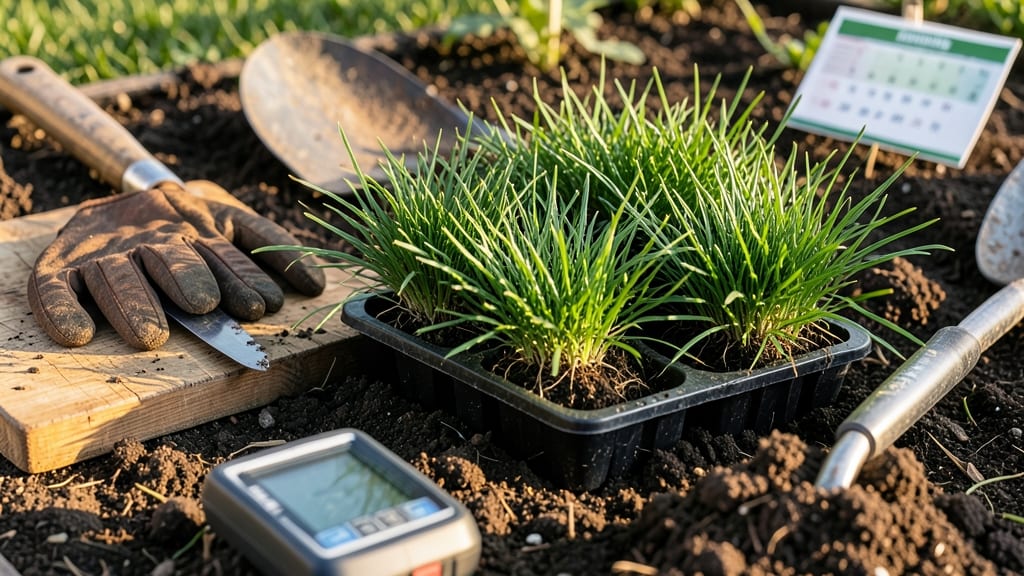
Here’s the critical rule: Soil temperature > air temperature. Use a soil thermometer to confirm—plant when the top 2–3 inches read 65°F+ for 5+ days. In SC, this typically aligns with mid-March for coastal areas and late March for Piedmont.
🌡️ Pro Tip: Use a soil thermometer to avoid guessing—Bermuda grass won’t germinate below 65°F!
If you’re planting Bermuda grass seed, aim for March 15–April 15 in most of SC. For sod installation, the window is slightly wider (March 1–May 1) because established sod handles cooler temps better.
However, sod planted in May or June may struggle to establish before summer heat sets in.
One common mistake? Planting Bermuda grass in February to “get a head start.” The risk? Soil temps are often below 60°F, causing seeds to rot or sprout unevenly. Wait for consistent warmth—patience here means faster, stronger growth later.
For Piedmont SC gardeners, monitor local frost data—some inland areas (e.g., Upstate) can see frost into April. Plant no earlier than April 1 unless you’re using sod, which tolerates slightly cooler soils. Coastal gardeners can push the envelope to late February if soil temps are stable.
Remember: Bermuda grass is aggressive and competitive, but only if given the right start. Plant at the wrong time, and you’ll spend the summer hand-watering weak patches or battling weeds. Get the timing right, and you’ll have a dense, drought-resistant lawn by summer’s end.
🌱 For extra confidence, test your soil’s moisture and temperature for 3–5 days before planting. Bury a thermometer 2 inches deep and check readings at 10 AM daily—this is how pros ensure success.
How to prepare your SC lawn for Bermuda grass success: soil, sun, and seedbed prep
Preparing your South Carolina lawn for Bermuda grass is just as critical as choosing the right planting window. Skipping prep steps often leads to patchy growth or weeds outcompeting your new grass. Start by testing your soil pH—Bermuda thrives in a range of 6.0 to 7.0.
If your soil is too acidic (below 6.0), add lime 4–6 weeks before planting. For alkaline soil (above 7.0), mix in sulfur or peat moss.
Next, clear your lawn of existing grass, weeds, and debris. Use a non-selective herbicide like glyphosate if needed, but wait 2–3 weeks before planting to avoid chemical damage.
For stubborn weeds, hand-pull or till the soil to 6 inches deep—this breaks up compacted layers and creates a better seedbed. Rake the area afterward to smooth the surface and remove clumps.